Before You Move In,
the Conversation.
Some understandings land more gently in words now, while you are choosing the doormat together. The agreement is just the room to put them down.
What you both want simply settled
Under One Roof, On One Page.
What she quietly hopes
“The little things I would like respected, without ever having to insist.”
What he quietly hopes
“The parts of the day I would like understood, without ever having to explain.”
Two quiet hopes, one shared address. Written kindly, by both of you.
Six things a live-in agreement actually covers
Inside the Agreement.
A bilateral cohabitation memo
Draft
- How rent and bills are shared
- What stays personal, what becomes shared
- Notice if either chooses to move out
- Furniture, deposits, and the things you bought together
- PWDV-Act protections, where they apply
- What changes if life shifts: parents, jobs, marriage
Plain language, no legalese. Drafted with both of you in a single 60-minute joint session, reviewed by an empanelled advocate under Indian law.
0%
Scroll
Partlee drafts live-in (cohabitation) agreements in India that record finances, property, and expectations, and remain aware of protections under the PWDV Act 2005.
Partlee is for adults only. The agreements drafted on this page carry legal effect only between consenting adults aged 18 or older.
The legal landscape
What Indian Law Actually Says.
01
A live-in is legally recognised.
The Supreme Court has repeatedly held that two consenting adults living together is not an offence and is, in many cases, a relationship in the nature of marriage. Indra Sarma (2013) and Velusamy (2010) draw the contours.
02
PWDV protection extends to many live-in partners.
Section 2(f) of the Protection of Women from Domestic Violence Act, 2005 covers a 'relationship in the nature of marriage', protection orders, residence rights, and monetary relief are available to a qualifying partner.
03
Children of live-in partners are legitimate.
The Supreme Court in Revanasiddappa (2011) and Bharatha Matha (2010) held that children born to a couple in a long-term live-in are legitimate, with property and inheritance rights from their parents.
04
There is no automatic property right.
Unlike marriage, a live-in does not create joint matrimonial property. What you bought separately stays separate. What you bought together is held by whoever's name is on the title, unless a written agreement says otherwise.
05
Maintenance is possible, but conditional.
A long-term, marriage-like live-in partner may seek maintenance under the Domestic Violence Act and, in some circumstances, under §125 CrPC. It is not automatic; it depends on the duration, the conduct, and the situation.
06
Cohabitation agreements are enforceable as contracts.
A bilateral, freely-signed cohabitation agreement is enforceable under the Indian Contract Act, 1872. It cannot waive statutory rights (PWDV, child welfare) but it can record everything else cleanly.
What we draft together
Eight Things Worth Putting on Paper.
The home
Whose name is on the lease or the title. Who pays the rent or EMI. What happens to the deposit and the household goods if either of you moves out.
Common questions
- Are live-in relationships legal in India?
- Yes, live-in relationships are legal in India. The Supreme Court has held that two consenting adults living together is not an offence, and a long-term relationship in the nature of marriage can attract protections under the Protection of Women from Domestic Violence Act, 2005.
- What does a live-in agreement cover?
- A live-in (cohabitation) agreement records how a couple will handle finances, shared property, expenses, and expectations while living together, and what happens if they separate. Partlee drafts it bilaterally, in plain language, so both partners agree to the same terms.
- Is a live-in agreement legally enforceable in India?
- A live-in agreement is treated as a contract under the Indian Contract Act, 1872, so its financial and property terms can carry weight; but matters like maintenance and protection from domestic violence are governed by law and cannot be signed away. Partlee is honest about what will and will not hold.
- Who reviews the live-in agreement?
- Each draft is reviewed by an empanelled advocate from a professional firm. Partlee builds the agreement with both partners; the advocate provides the legal review.
Money and contributions
How you split bills, groceries, holidays, and one-off expenses. What gets pooled, what stays separate. The accounts, the credit cards, the loans.
Common questions
- Are live-in relationships legal in India?
- Yes, live-in relationships are legal in India. The Supreme Court has held that two consenting adults living together is not an offence, and a long-term relationship in the nature of marriage can attract protections under the Protection of Women from Domestic Violence Act, 2005.
- What does a live-in agreement cover?
- A live-in (cohabitation) agreement records how a couple will handle finances, shared property, expenses, and expectations while living together, and what happens if they separate. Partlee drafts it bilaterally, in plain language, so both partners agree to the same terms.
- Is a live-in agreement legally enforceable in India?
- A live-in agreement is treated as a contract under the Indian Contract Act, 1872, so its financial and property terms can carry weight; but matters like maintenance and protection from domestic violence are governed by law and cannot be signed away. Partlee is honest about what will and will not hold.
- Who reviews the live-in agreement?
- Each draft is reviewed by an empanelled advocate from a professional firm. Partlee builds the agreement with both partners; the advocate provides the legal review.
Property, separate and shared
A schedule of what each of you owned before. A schedule of what you've acquired together. Title, ownership share, and what happens on separation.
Common questions
- Are live-in relationships legal in India?
- Yes, live-in relationships are legal in India. The Supreme Court has held that two consenting adults living together is not an offence, and a long-term relationship in the nature of marriage can attract protections under the Protection of Women from Domestic Violence Act, 2005.
- What does a live-in agreement cover?
- A live-in (cohabitation) agreement records how a couple will handle finances, shared property, expenses, and expectations while living together, and what happens if they separate. Partlee drafts it bilaterally, in plain language, so both partners agree to the same terms.
- Is a live-in agreement legally enforceable in India?
- A live-in agreement is treated as a contract under the Indian Contract Act, 1872, so its financial and property terms can carry weight; but matters like maintenance and protection from domestic violence are governed by law and cannot be signed away. Partlee is honest about what will and will not hold.
- Who reviews the live-in agreement?
- Each draft is reviewed by an empanelled advocate from a professional firm. Partlee builds the agreement with both partners; the advocate provides the legal review.
Health, emergencies, decisions
Who can be informed in a hospital. Who can make medical decisions if one of you is incapacitated. The legal weight is limited but the documented intent helps.
Common questions
- Are live-in relationships legal in India?
- Yes, live-in relationships are legal in India. The Supreme Court has held that two consenting adults living together is not an offence, and a long-term relationship in the nature of marriage can attract protections under the Protection of Women from Domestic Violence Act, 2005.
- What does a live-in agreement cover?
- A live-in (cohabitation) agreement records how a couple will handle finances, shared property, expenses, and expectations while living together, and what happens if they separate. Partlee drafts it bilaterally, in plain language, so both partners agree to the same terms.
- Is a live-in agreement legally enforceable in India?
- A live-in agreement is treated as a contract under the Indian Contract Act, 1872, so its financial and property terms can carry weight; but matters like maintenance and protection from domestic violence are governed by law and cannot be signed away. Partlee is honest about what will and will not hold.
- Who reviews the live-in agreement?
- Each draft is reviewed by an empanelled advocate from a professional firm. Partlee builds the agreement with both partners; the advocate provides the legal review.
If you separate
A patient framework, who keeps what, how the lease unwinds, the handling of joint accounts, the timeline. Not a gun, a guide. PWDV rights are explicitly preserved.
Common questions
- Are live-in relationships legal in India?
- Yes, live-in relationships are legal in India. The Supreme Court has held that two consenting adults living together is not an offence, and a long-term relationship in the nature of marriage can attract protections under the Protection of Women from Domestic Violence Act, 2005.
- What does a live-in agreement cover?
- A live-in (cohabitation) agreement records how a couple will handle finances, shared property, expenses, and expectations while living together, and what happens if they separate. Partlee drafts it bilaterally, in plain language, so both partners agree to the same terms.
- Is a live-in agreement legally enforceable in India?
- A live-in agreement is treated as a contract under the Indian Contract Act, 1872, so its financial and property terms can carry weight; but matters like maintenance and protection from domestic violence are governed by law and cannot be signed away. Partlee is honest about what will and will not hold.
- Who reviews the live-in agreement?
- Each draft is reviewed by an empanelled advocate from a professional firm. Partlee builds the agreement with both partners; the advocate provides the legal review.
Children, present or future
If you have a child, paternity acknowledgement and joint parenting framework. If you intend to have one, the conversation in writing, schooling, decisions, residence.
Common questions
- Are live-in relationships legal in India?
- Yes, live-in relationships are legal in India. The Supreme Court has held that two consenting adults living together is not an offence, and a long-term relationship in the nature of marriage can attract protections under the Protection of Women from Domestic Violence Act, 2005.
- What does a live-in agreement cover?
- A live-in (cohabitation) agreement records how a couple will handle finances, shared property, expenses, and expectations while living together, and what happens if they separate. Partlee drafts it bilaterally, in plain language, so both partners agree to the same terms.
- Is a live-in agreement legally enforceable in India?
- A live-in agreement is treated as a contract under the Indian Contract Act, 1872, so its financial and property terms can carry weight; but matters like maintenance and protection from domestic violence are governed by law and cannot be signed away. Partlee is honest about what will and will not hold.
- Who reviews the live-in agreement?
- Each draft is reviewed by an empanelled advocate from a professional firm. Partlee builds the agreement with both partners; the advocate provides the legal review.
The conversation, recorded
Family expectations on each side. Marriage, or no marriage, and on what timeline. Visiting in-laws. The shape of the relationship, in your own words.
Common questions
- Are live-in relationships legal in India?
- Yes, live-in relationships are legal in India. The Supreme Court has held that two consenting adults living together is not an offence, and a long-term relationship in the nature of marriage can attract protections under the Protection of Women from Domestic Violence Act, 2005.
- What does a live-in agreement cover?
- A live-in (cohabitation) agreement records how a couple will handle finances, shared property, expenses, and expectations while living together, and what happens if they separate. Partlee drafts it bilaterally, in plain language, so both partners agree to the same terms.
- Is a live-in agreement legally enforceable in India?
- A live-in agreement is treated as a contract under the Indian Contract Act, 1872, so its financial and property terms can carry weight; but matters like maintenance and protection from domestic violence are governed by law and cannot be signed away. Partlee is honest about what will and will not hold.
- Who reviews the live-in agreement?
- Each draft is reviewed by an empanelled advocate from a professional firm. Partlee builds the agreement with both partners; the advocate provides the legal review.
What we do not include
Anything that purports to waive PWDV protection, child welfare, or any statutory right. We will not draft those clauses. Our job is to record what you've agreed; it is not to take away what the law gives you.
Common questions
- Are live-in relationships legal in India?
- Yes, live-in relationships are legal in India. The Supreme Court has held that two consenting adults living together is not an offence, and a long-term relationship in the nature of marriage can attract protections under the Protection of Women from Domestic Violence Act, 2005.
- What does a live-in agreement cover?
- A live-in (cohabitation) agreement records how a couple will handle finances, shared property, expenses, and expectations while living together, and what happens if they separate. Partlee drafts it bilaterally, in plain language, so both partners agree to the same terms.
- Is a live-in agreement legally enforceable in India?
- A live-in agreement is treated as a contract under the Indian Contract Act, 1872, so its financial and property terms can carry weight; but matters like maintenance and protection from domestic violence are governed by law and cannot be signed away. Partlee is honest about what will and will not hold.
- Who reviews the live-in agreement?
- Each draft is reviewed by an empanelled advocate from a professional firm. Partlee builds the agreement with both partners; the advocate provides the legal review.
How a Live-in Agreement runs
Cohabitation, written down - honest about Indian-law recognition.
Four steps to a bilateral cohabitation agreement that includes PWDV-aware clauses, property terms, and a plain exit framework.
Step I of IV
Bilateral builder.
Both partners draft from separate sessions. Cohabitation terms, financial overlap, child-of-the-relationship clauses, and exit framework get covered first.
Both partners · separate sessions
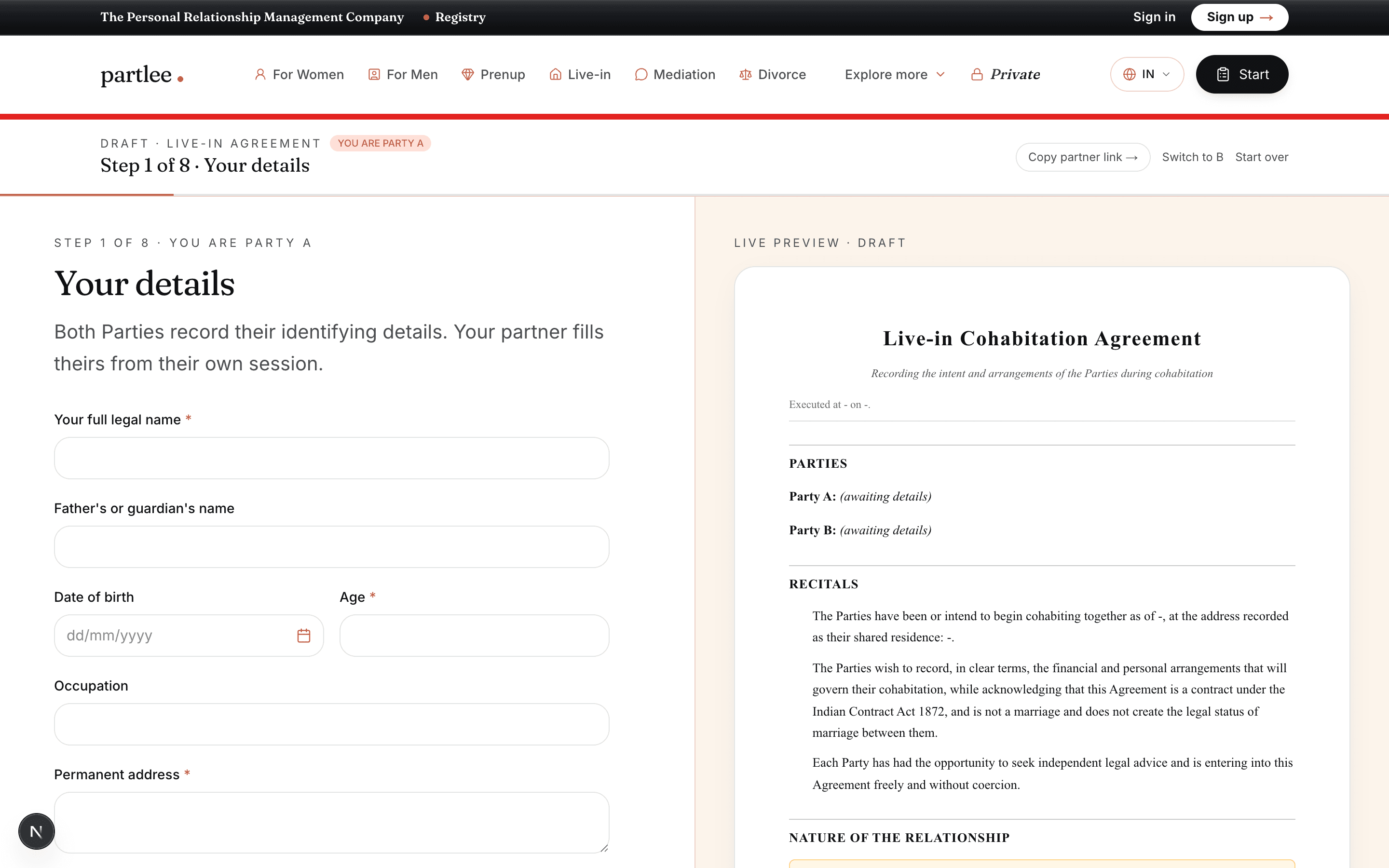
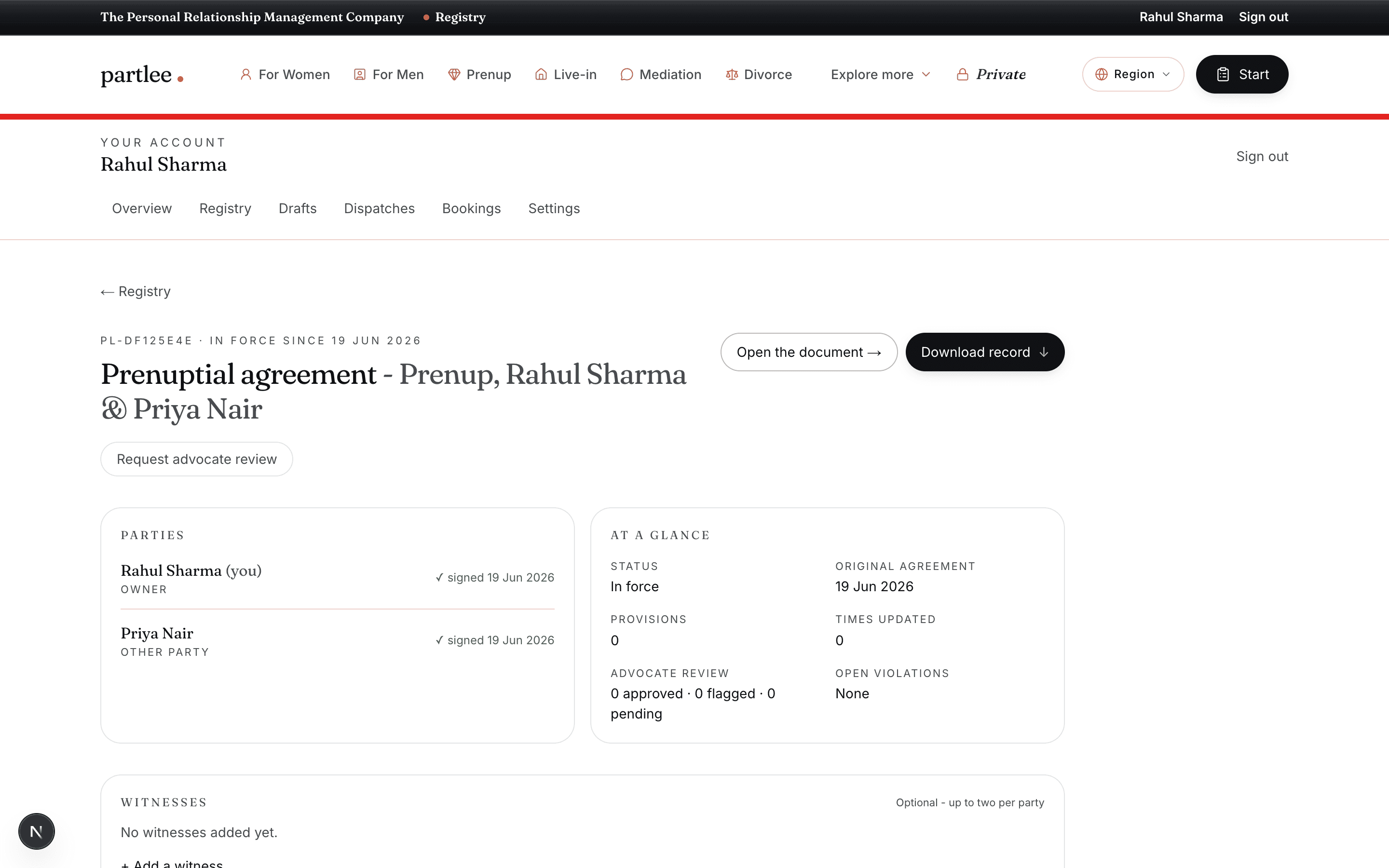
Step I · Bilateral builder
The four steps, at a glance
See the same arc across every track in the full walkthrough.
Why couples do this
The Conversation, In Writing.
Most live-in couples in India do not have this conversation in writing. Most have it in fragments, a text message, a passing remark in the kitchen, a fight that ends without resolution. The agreement is not a reaction to mistrust; it is the same conversation, written down once, calmly, with both people in the room.
Couples who do this report the same thing: it does not feel like a contract. It feels like the small relief of having said the thing.
Honest limits
We are honest about what this can and cannot do.
A cohabitation agreement is not a marriage. It does not give you the rights of a spouse under the Hindu Marriage Act, the Special Marriage Act, or the personal laws. It does not, by itself, create a right to inherit from your partner.
It is a contract. It binds the two of you, on the things you can lawfully agree on, for as long as you live together. It is admissible evidence if a dispute arises. It is not a substitute for a will, an HUF settlement, or a marriage registration.
We will tell you, before any drafting, where the document is strong and where the law overrides it. The clause that protects against domestic violence cannot be waived. The clause about children cannot bind a future court’s view of welfare. We say this on the first page of the agreement, in plain language.
